Historic Cat 5 Melissa Flattens Jamaica
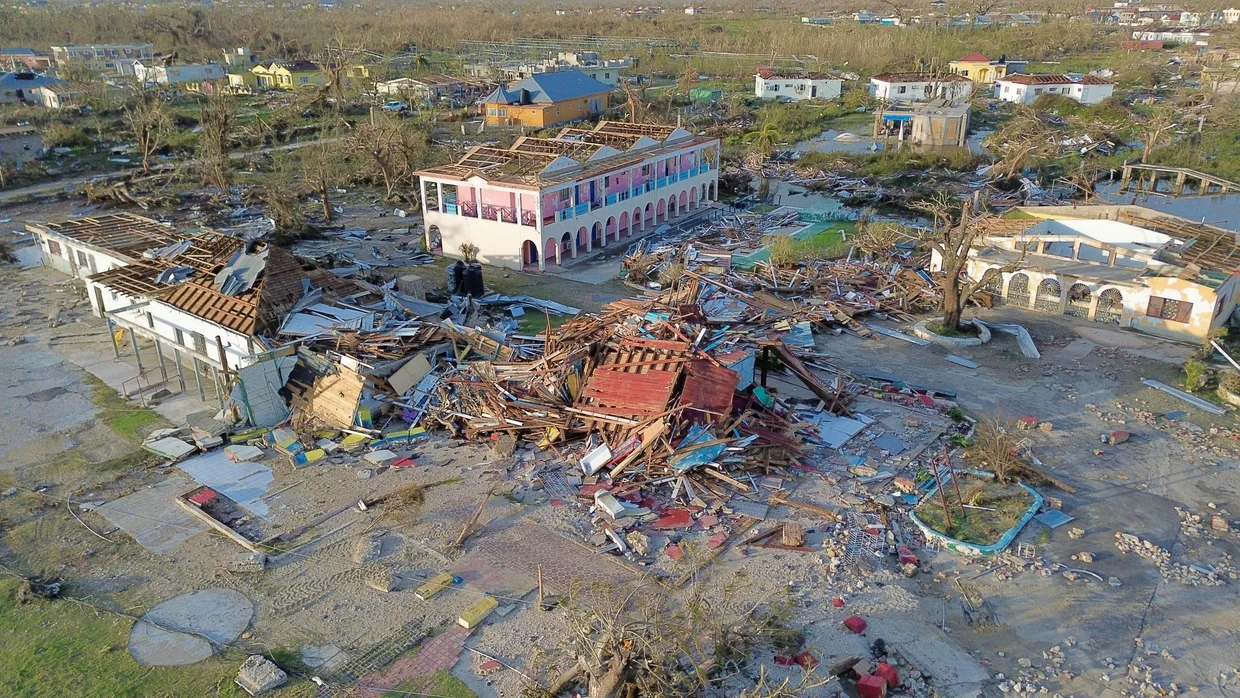
Hello! Incredibly, Melissa was the third Category 5 Hurricane in the 2025 summer-fall season! The two other Cat 5’s were Hurricane Erin in August 2025 and Hurricane Humberto in September 2025.
Hurricane Melissa was size of Texas and exploded to a Cat 5 very quickly. According to NOAA, “It had a minimum central pressure of 892 millibars tying it with the1935 Labor Day hurricane. Only Gilbert and Wilma were ahead of Melissa.”
Because of Melissa’s rapid intensification, it will be reviewed by the “National Hurricane Center in the months ahead, so where the storm ultimately ranks in history could change.”
Why are there So Many Rapidly Intensifying Cat 5 Hurricanes?
Looking at Hurricane Melissa, “the water around Jamaica had been simmering all summer. By the time Melissa roared ashore on October 28th, that uber-warm Caribbean Sea had helped turn it into a monster: a Category 5 storm with winds reaching 185 miles an hour, tied for the strongest Hurricane to strike land in the Atlantic.”
Once again experts say Melissa is a “visceral example of what climate change can do to the planet’s most fearsome storms – supercharging them with heat and moisture until they become almost unrecognizable from the Atlantic hurricanes of the past.”
“Three days before landfall, Hurricane Melissa underwent two periods of rapid intensification as it traversed ocean water that were about 2.5 degrees Fahrenheit warmer than average for this time of year.”
According to the research group Climate Central, “Human-caused climate change made such hot water far more likely.”
“And as it moved through those extremely warm waters, Hurricane Melissa’s maximum sustained winds doubled from 70 mph — a tropical storm — on the morning of [Saturday October 25th] to a 140 mph Category 4 hurricane just 24 hours later.”
“Then from Sunday afternoon [October 26th] through Monday afternoon [October 27th], its peak winds spiked again, going from 140 mph to 175 mph. It then intensified further overnight Monday into Tuesday morning during its final approach to the Jamaican coast [on October 28th].”
Steve Brown, Chief Scientist at Gallagher Re said, “This type of hurricane behavior is becoming more common. We’ve seen a notable uptick in the rates of explosive intensification, with winds increasing by at least 60 mph in 24 hours across most ocean basins, during the past four decades or more. It’s what scientists have been predicting: Hotter oceans are going to support top-tier intensity hurricanes. In short, nature continues to reaffirm the basic laws of thermodynamics.
Kerry Emanuel, a veteran hurricane researcher at MIT said, “We are now seeing evidence of greater human-caused influences on these massive storms. This is the third Category 5 tropical cyclone in the Atlantic this year, and the other two also went through periods of rapid intensification. Taken together, this season might be said to be consistent with what we have been saying for some time which is that: The proportion of global tropical cyclones reaching high intensity is increasing, as is the incidence of rapidly intensifying storms.”
Here’s an Excellent Way to Talk to Kids with “Soft Facts” about Climate Change and Pollution …
One awesome tool for talking to kids about climate change and pollution is to read my fourth installment in the award-winning Kobee Manatee® Children’s Educational Picture Book series. It’s titled, Kobee Manatee® Climate Change and The Great Blue Hole Hazard. It contains “soft facts” about climate change and plastic pollution in our oceans.
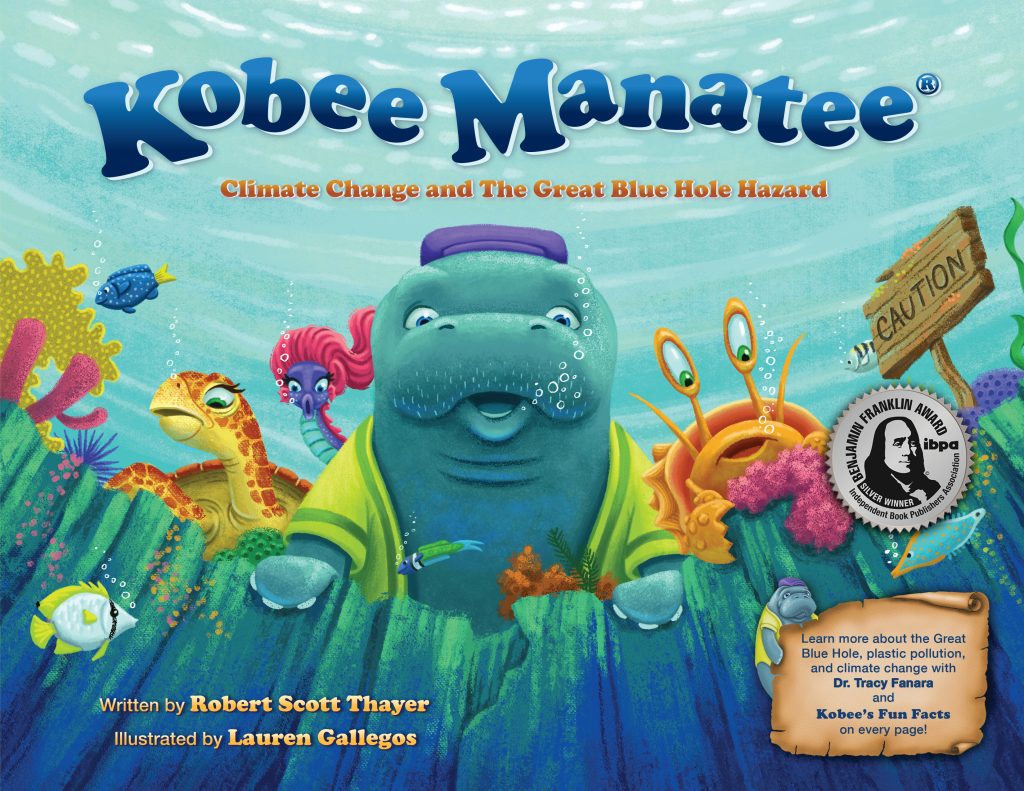
When you read this award-winning educational picture book to children, you’ll quickly see it’s a fun and fictional adventure loaded with weaved in “soft facts” on climate change and plastic pollution. Clearly, this helps children learn about this serious subject in a fun and entertaining way. Here’s a brief synopsis …
Kobee Manatee, the protagonist and his seafaring pals, Tess the seahorse and Pablo the hermit crab swim from the Cayman Islands to Belize. Kobee wants to help his cousin Quinn clean up plastic litter at her new, all-veggie underwater bistro called Quinn’s Seagrass Café.
On their Caribbean journey they encounter harmful effects of climate change and plastic pollution. As if that wasn’t enough, several other unforeseen problems occur with a distressed loggerhead turtle, a giant Portuguese man-of-war, and a venomous scorpionfish. They’re all amazed when they discover the extraordinary Great Blue Hole. Then their adventure takes another crazy turn when Pablo plunges into its huge abyss!
Each page includes in-depth, scientific details on climate change and plastic pollution in our oceans with Dr. Tracy Fanara, Environmental Engineer, Scientist and Science Communicator (aka Inspector Planet). Tracy can be seen on The Weather Channel as a visiting expert and she’s also been seen on their “Weird Earth” segments.
We have Fantastic Reviews on this New Release!
“I read the book to my 6-year-old this morning while he was having his breakfast before school and he loved it! We talked about the characters, what it meant for the pollution to be in the oceans for all the sea creatures, and how fun the story was. Thank you so much for writing such a great story for kids that is not only entertaining, but has a message!” – Jessica Vilchis, Co-Host KNBC California Live
“A well-crafted, thoughtful, and well-illustrated addition to a noteworthy educational book series.” —Kirkus Reviews
“Robert Scott Thayer presents an important environmental message in an engaging story with wonderful characters. Anyone who loves the ocean and wants to help save it should read Kobee Manatee: Climate Change and The Great Blue Hole Hazard. I’m looking forward to the next Kobee Manatee adventure.” —Readers’ Favorite
For young readers who enjoy imaginative tales surrounding affable and heroic sea creatures, as well as parents and/or teachers looking for a way to introduce youngsters to the importance of marine conservation, Kobee Manatee® Climate Change and The Great Blue Hole Hazard offers a perfect blend. Highly recommended! – Chanticleer Book Reviews
Keep watching for more of my updates on climate change!
If you see any sick or injured manatees, please call the Florida Fish and Wildlife Conservation Commission at: 1-888-404-3922 (FWCC). They are the folks who are responsible for rescuing us in Florida.
Here’s the Save the Manatee Club link to learn more about us manatees …
Here’s a cool link for you to learn more about how we’re rescued and brought into rehabilitation …
~ Robert Scott Thayer
Related Posts
Hurricane Erin Explodes in Intensity
https://www.kobeemanatee.com/hurricane-erin-explodes-in-intensity-%ef%bf%bc/
Did “Climate Change” Cause Back-to-Back Major Hurricanes Harvey and Irma?
Dr. Tracy Fanara aka Inspector Planet Uncovers Extraordinary Science Nuggets!


