Christmas Trees Celebrate the Season Underwater
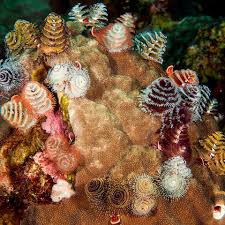
Happy Holidays to you! Tradition shows that Christmas trees are a naturally fun and festive part of the December Holiday celebration. Now picture Christmas trees living their entire life underwater! Yes indeed. Here’s some awesome Holiday news for you from the National Oleanonic and Atmospheric Administration (NOAA).
“You won’t find Spirobranchus giganteus, also known as the Christmas tree worm, eating your fir tree this year. The common name for these worms is derived from their appearance, not their habitat or diet.
Each worm has two brightly colored crowns that protrude from its tube-like body. These Christmas tree-like crowns are composed of radioles, or hair-like appendages radiating from the worm’s central spine. These appendages are used for respiration and to catch dinner, which typically consists of microscopic plants, or phytoplankton, floating in the water.
These worms are sedentary, meaning that once they find a place they like, they don’t move much. In fact, while the colorful crowns of these worms are visible, most of their bodies are anchored in burrows that they bore into live coral. When startled, Christmas tree worms rapidly retract into their burrows, hiding from would-be predators.
Christmas tree worms come in a variety of bright colors. They aren’t very big, averaging about 3.8 centimeters in length. However, because of their distinctive shape, beauty, and color, these worms are easily spotted. They are some of the most widely recognized polychaetes, or marine burrowing, segmented worms out there.”
So as confirmed from NOAA Christmas can also be celebrated underwater! Scientists first discovered the Christmas Tree Worm and all of their beauty in 1766. Their awesome looking tree top crown also comes in a variety of fantastic colors. Just about any color you can think of. These living organisms are filter feeder and get nutrition from the water surrounding them. And here’s what’s even more interesting – you can only see the worm’s crown, which happens to be visible in the beautiful shape of a Christmas tree! Christmas Tree worms are not very big at all. In fact, they only average about 1.5 inches in length. But I’m sure you’ll agree, they sure know how to throw out some truly magnificent colors!
The Christmas Tree Worm’s body is hidden within the host coral where it lives. You can usually find several Christmas Tree Worms living in the same area. As a result, they are sedentary
Each worm has two bright colored crowns, which extend up from its tube-shaped body. And their brilliantly colored Christmas tree crowns are actually made of radioles(hair-like appendages growing from the worm’s central spine). The Christmas tree worm uses these appendages to catch its food, which mainly consists of microscopic plants, or phytoplankton, which floats about in the water.
If something swimming nearby startles a Christmas Tree Worm, it quickly disappears into its coral burrow, hiding from any approaching predator. According to a recent study, Christmas Tree Worms “may live for a decade or more (some for more than 40 years), based on counting the annual growth bands in the coral skeleton overlaying polychaete tubes.”
Researchers discovered the Christmas tree worm might actually protect certain types of corals from bleaching. Now that sure is a very good thing!
HAPPY HOLIDAYS!!!
If you are in Florida and you see a sick or injured manatee, please call the Florida Fish and Wildlife Conservation Commission at: 1-888-404-FWCC. They are the folks who are responsible for rescuing us in Florida.
Here’s the Save the Manatee Club link to learn more about manatees …
Here’s a cool link for you to learn more about how we’re rescued and brought into rehabilitation …
~ Robert Scott Thayer
Related Posts


